
“When I Go” – Conversations with Death 8
<<<Back to page 1
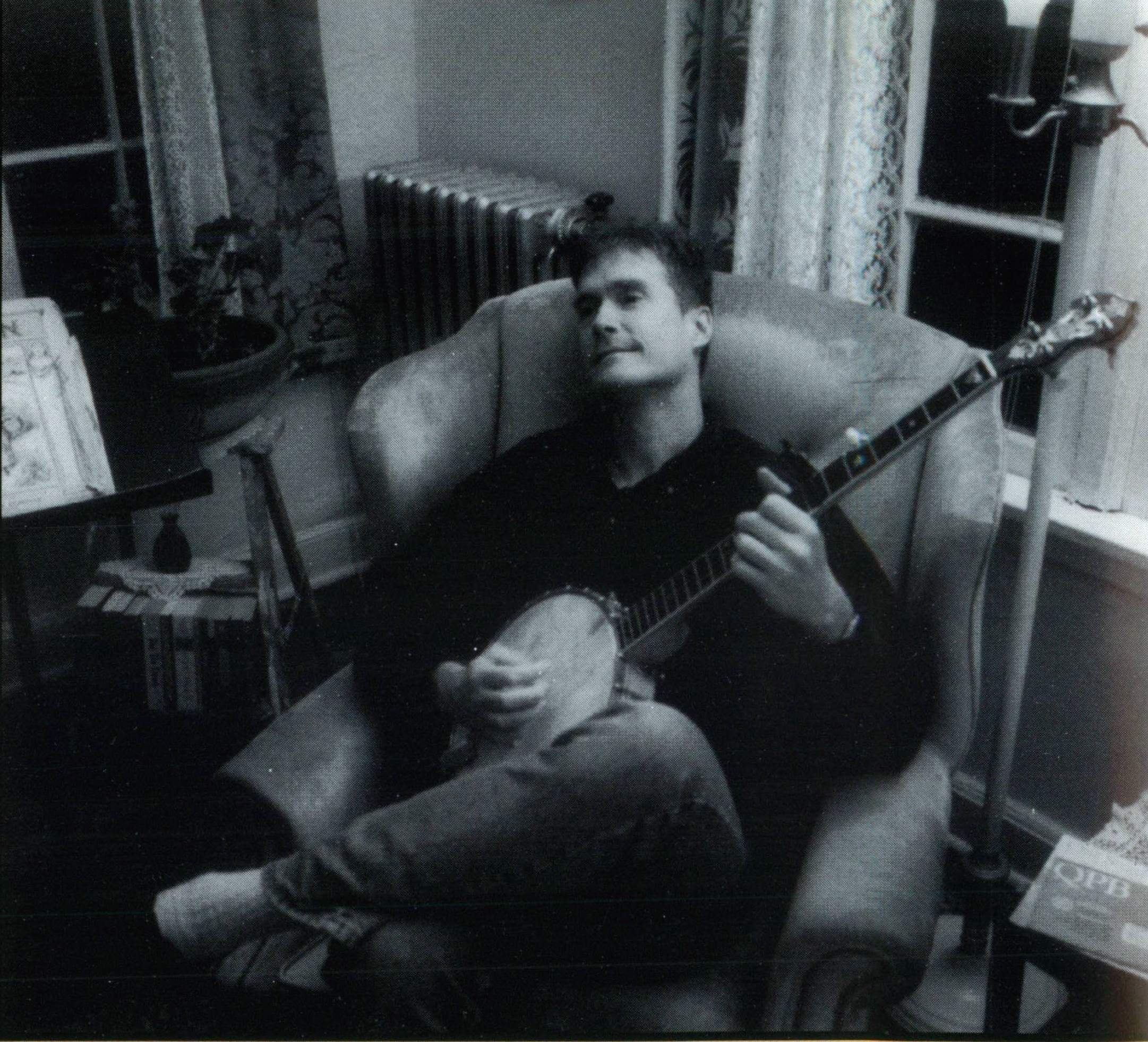
Dave Carter (photo by Dan Betenbender, courtesy of Tracy Grammer)
Unlike those who find the banjo a bright, “chipper” instrument, Carter felt it “sounded like the click and clack of old bones,” according to Grammer. He acquired the banjo by accident when a Portland music shop salesman threw it in at a low price to sweeten the deal when Carter was shopping for a new guitar.
Grammer explains “I believe the raw sound of the banjo met the raw emotion Dave was feeling regarding his mother, and the resulting song is the confluence. Had he tried to write the song on guitar, it would not have come out the same. Instrument and intent, along with everything that made Dave Carter the mystical, poetic songwriter he was, informed the birth of this masterpiece.” (You can watch Carter give a tutorial of how to play the song on the banjo here.)
“When I Go” won three songwriting contests before Carter and Grammer recorded it for the album. It was a staple of their live act from beginning to end. Grammer recounts, “Three weeks before he died, I asked Dave if he had written the song for himself. I always found the imagery a bit bold and masculine for a mother. He just looked at me and smiled.”
Carter died of a heart attack after a morning run in Northhampton, Massachusetts, about a week before the duo were scheduled to appear at the July 2002 Falcon Ridge Folk Festival. Grammer said, “When they finally let me visit him in the hospital after he died, the first words that came to mind were: ‘fly like the falcon’.”

(photo by Tom Koerner/USFWS, from flickr)
“The trick is to learn the song from God”
North America tended to strip arriving European ballads of their magical elements. The faeries, daemon lovers, and spirits of that world did not survive here. It’s not entirely clear to me what drove this secularization of the old ballads, whether it was an impulse toward a kind of modernization or a religious impulse in a predominantly Christian culture to push out traces of pagan traditions.
Carter’s songwriting, similar in this way to Robert Hunter’s, creates new musical mythology in the American context. Carter viewed songwriting as a mystical process. It should not surprise us that his songs enchant the American landscape.
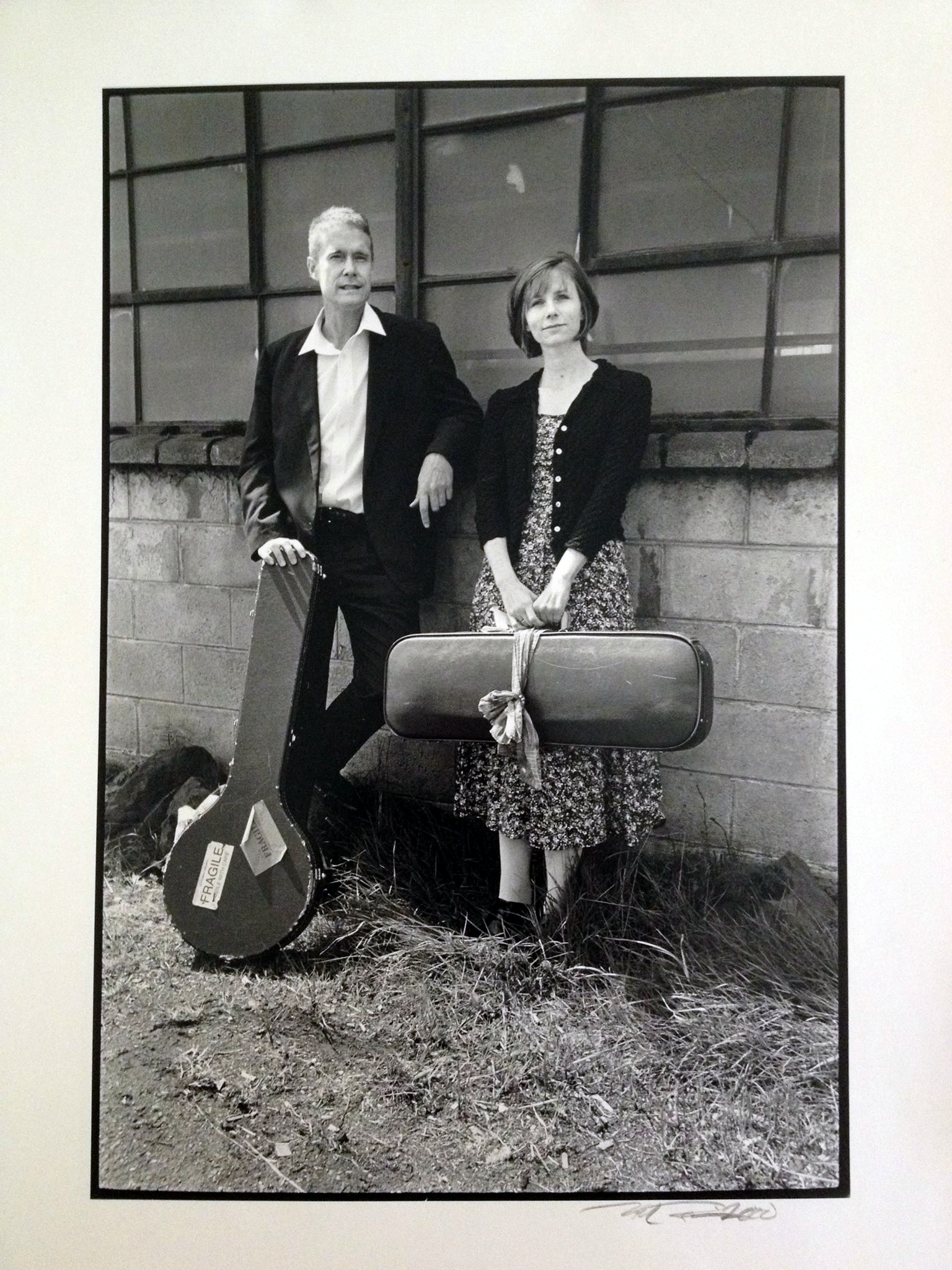
Dave Carter and Tracy Grammer in 2000
(photo by Mark Rabiner)
Carter’s encounter with “the mystical” entailed parting ways with some of his Pentecostal upbringing, although his “shamanistic” approach has parallels with his mother’s tradition of speaking in tongues. Carter’s influences were broad—invoking indigenous symbols and New Age sources, like Carlos Castaneda, as well as Buddhist texts. In addition to extensive study in mathematics, he also studied transpersonal psychology (or the psychology of mystical experience).
The poetry is magnificent. At first, the flurry of words seems impossible to sing, but as you immerse yourself in the song its consonants and concepts flow with a compelling rhythm. Spending further time with it, you discover more of the internal rhymes and cadences.
The transfigurations in its imagery share a common spirit, but a variety of manifestations. While much of it draws from natural symbols, some vestiges of Christian visions of the afterlife filter in “between death and resurrection.” I have no clean way to sum up the sources of the song’s worldview. That it creates a common thread among these images is a sign of the song’s power and success, and of Carter’s gifts.
“Stand in the mist where my fire used to burn”
Something, though, quietly nudged me from within the song, echoing off other things I’d read and heard.
After I wrote a post last year about murder ballads adapted from Edgar Lee Masters’s Spoon River Anthology, I wanted to explore Masters’s work further. What I learned only after writing the “Spoon River Murder Ballads” post was that Masters drew inspiration from the philosophy of Baruch Spinoza. The poem cycle, which provides virtual epitaphs of 244 citizens of the fictional town of Spoon River, represents Masters’s exploration of Spinoza’s metaphysics. Spinoza held that there is no real separation between God and nature. Each individual human experience represents a tiny, partial fragment of the all-encompassing divine experience.
Here is how John Wild describes Spinoza’s view, cited by Masters scholar John E. Hallwas, in his introduction to the Anthology.
“Such then is the hard and lonely way which the soul must take in order to loose itself from the trammels of finitude which bind it to the body, in order to realize its own essential nature and find its place in the eternal community of rational intellects which make up God. The person whose self is most real, whose eternal individuality is most concrete and valuable, is he who devotes himself most thoroughly and unswervingly to the search for truth—not mere theory but the knowledge that vitalizes conduct….Such a mind which thinks truly becomes one with the real which it thinks. It does not lose itself in the absolute, but through its intimate relations with the rest of reality becomes more uniquely itself.”
Sound familiar? Spinoza held a rational and deterministic view. For him, the human drama plays out as a function of sheer cause and effect. This is part of what Masters captures in the interwoven stories of Spoon River’s denizens. Carter’s vision is not rational, but he evinced that same devotion to search for truth, and most thoroughly. In teaching aspiring songwriters, Carter noted “a shift in poetry toward the rational. The songwriter has to go the other direction.” The soul loosing itself from the trammels of finitude is very much what “When I Go” is all about.