
BANG BANG: POP! goes the murder ballad
<<<Back to page 2
Bang! Wizz! Zap! Pow!
“Bang Bang” is also a schtick, but a forceful and purposeful one, a comic strip version of the folk-based murder ballad tradition, and one that works in much the same way as a comic strip does. BANG BANG! – one can easily visualize those words as one frame in a comic strip followed by another in which a tearful woman laments, via thought bubble, that “He didn’t even say goodbye!,” a la Roy Lichtenstein.

Roy Lichtenstein, “Hopeless” (1963)
And, in fact, Lichtenstein is very relevant, as David Guetta’s 2014 version of “Bang Bang” – currently the most popular with over 150 million views on YouTube – illustrates:
Lichtenstein’s pop art was saying something important about women and power in the 1960s, and also something important about the American fetish with the gun. What might it look like, as a woman, or as a population generally, to be staring down the barrel of a gun all the time? In 1968, Lichtenstein’s iconic “Pistol” was forcing the question on the cover of Time. The introduction to the cover story sounds like something that could be written today:
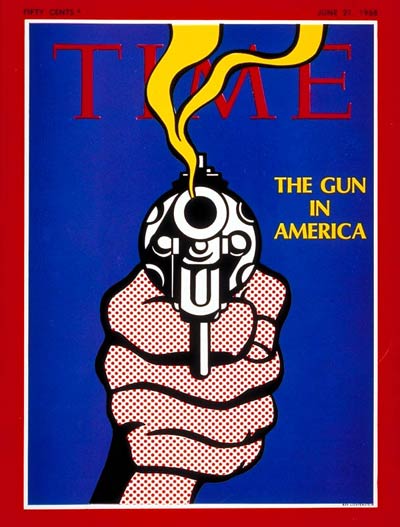
Roy Lichtenstein, “Pistol.” Cover of Time Magazine 1968
“Forget the democratic processes, the judicial system and the talent for organization that have long been the distinctive marks of the U.S. Forget, too, the affluence (vast, if still not general enough) and the fundamental respect for law by most Americans. Remember, instead, the Gun. That is how much of the world beyond its borders feels about the U.S. today. All too widely, the country is regarded as a blood-drenched, continent-wide shooting range where toddlers blast off with real rifles, housewives pack pearl-handled revolvers, and political assassins stalk their victims at will.The image, of course, is wildly overblown, but America’s own mythmakers are largely to blame. In U.S. folklore, nothing has been more romanticized than guns and the larger-than-life men who wielded them.”
Seen in this context, Raquel Welch’s unforgettable television performance of “Bang Bang” in 1967 is also something other than just silly and embarrassing: it says a lot about how Americans saw women, guns, and violence, and how when all three were viewed together it became titillating popular entertainment. Here we have America’s #1 sex symbol on stage, dancing in white short-shorts for a prime-time television audience, as a band of black-clad ninja-looking men shoot at (and hit) her with mock assault rifles. You can’t make this up:
Ken’s recent discussion of “The Body Electric” seems relevant. I don’t agree with everything that Hurray for the Riff Raff’s Alynda Lee Segarra claims in regard to that song, but this bit seems pertinent: “There was just something that popped into me at that moment when I was listening to the song, where I suddenly realized, this person is so disconnected from what they’re saying. It was one of those moments when you’re like, the whole world has gone crazy!”
As Welch’s performance makes clear, everybody doesn’t just shrug it off, though. Some find it downright sexy. Metaphors run amok as “bang bang” becomes a come on, even a declaration of love. Guetta’s cover shows how this still works today, as does will.i.am’s interpretation of “Bang Bang” as part of the film score for The Great Gatsby (2013):
Macy Gray’s almost complete reinvention of the song goes further. “Bang Bang” is still hot, apparently, and even hotter when it’s the woman who is shooting.